Guiding Better Field Execution
Helping Research Associates perform client-specific work with confidence by bringing operational guidance directly into their workflow.
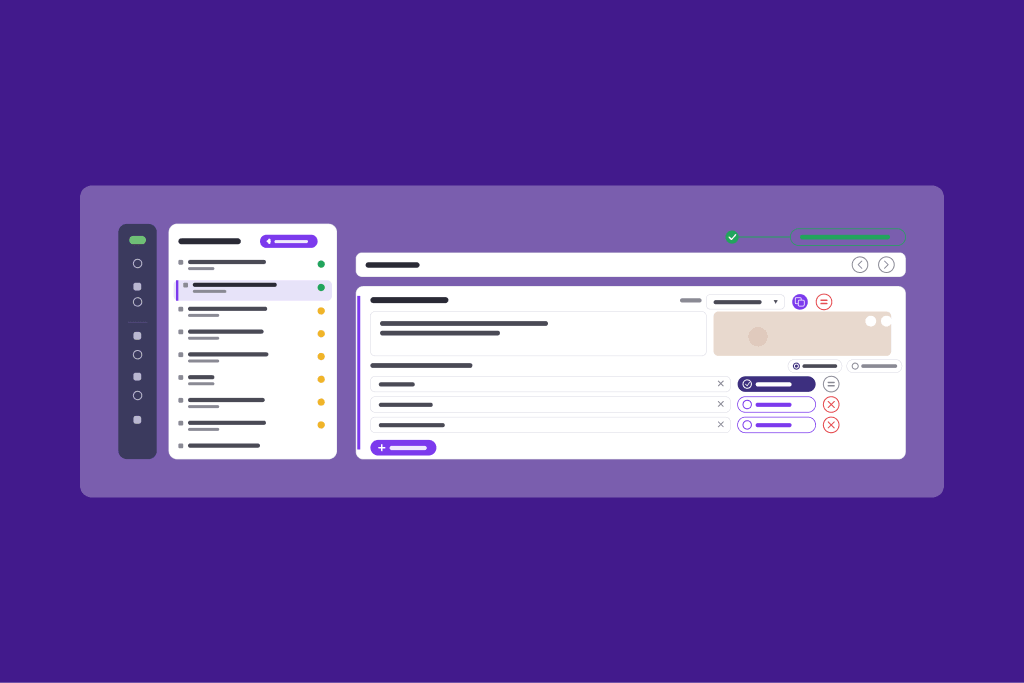
The best training experience is one that feels like part of the work-not something separate from it.
Project at Glance
- Designed an integrated guidance platform replacing a disconnected third-party LMS within the InfoQuest ecosystem
- Created connected web and mobile experiences - guidance moves seamlessly from creation to field execution
- Defined the MVP strategy: contextual guidance over traditional LMS features like certifications and progress tracking
- Established the foundation for Quest-based assignments, workflow enforcement, and richer media
why this project matters
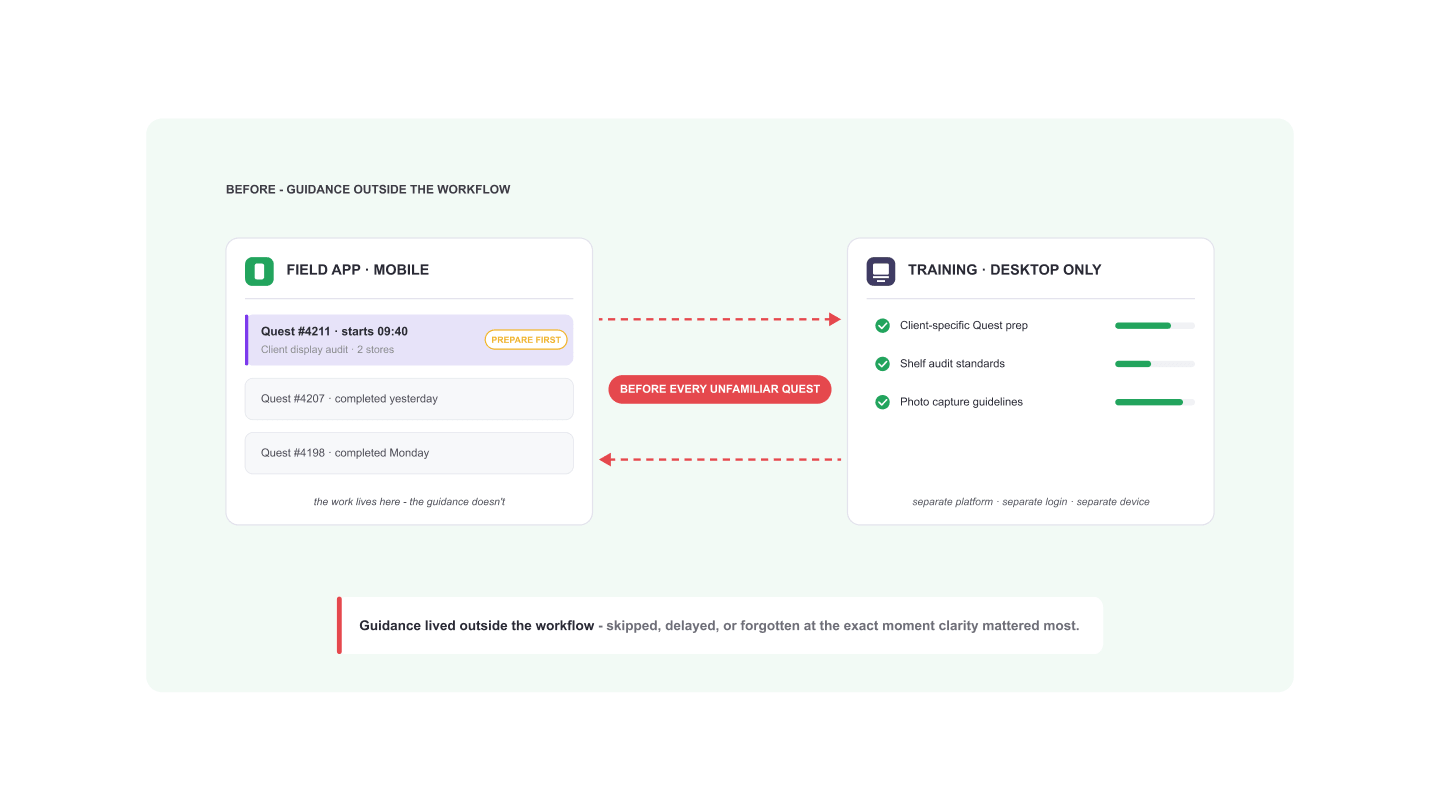
Research Associates prepare for client-specific Quests through a desktop-only training platform that sits outside their mobile-first workflow - so guidance gets skipped, delayed, or forgotten right when it matters. I designed an operational guidance module inside the InfoQuest ecosystem that delivers that preparation inside the field workflow itself. The MVP is currently in development, planned for release in early 2027.
Problem & Context
Understanding the Problem
Business Context
InfoQuest is an enterprise retail intelligence platform: brands commission field research, and Research Associates collect that data inside stores as client-specific jobs called Quests. Every Quest has its own instructions and success criteria - and completing the work isn't enough. The quality of the data depends on understanding exactly what the client expected to be captured.
The Challenge
Build an internal Learning Management System.
That was the request - and it seemed straightforward. But the business already had one: a third-party platform, desktop-only, disconnected from the field application. The real problem wasn't a missing product; it was guidance living outside the workflow where Research Associates actually work:
- Training was skipped or delayed before unfamiliar Quests
- Client-specific expectations were harder to reference when work began
- Inconsistent execution led to poor-quality data, rework, and client dissatisfaction
What looked like a product request was a workflow problem - and understanding that distinction became the turning point of the project.
Research & Systems
Looking Beyond the Feature Request
Discovery
The brief: replace the third-party LMS with an internal one. Before designing anything, I mapped the existing training workflow with the Product Manager, Business Analyst, Engineering team, and Field Operations Managers - and kept asking one question:
Why does this training exist in the first place?
The answer reframed everything. Research Associates weren't training to learn their jobs - they were preparing for client-specific Quests. The platform wasn't failing because it lacked learning features; it was failing because guidance was disconnected from the work itself.
The Shift in Perspective
"Build an LMS" carries assumptions - courses, assessments, certificates, pass percentages. None of them addressed the actual need: preparing someone for unfamiliar work. The question changed:
How do we deliver the right guidance at the exact moment someone is about to perform unfamiliar work?
Once reframed, certifications, pass thresholds, and training expiry were deprioritized. Every decision was measured against a simpler principle:
Will this help a Research Associate perform their next Quest with greater confidence?
01
Guidance Over Grading
"Designing the Right Product"
The reframed problem changed what we needed to build: not a traditional LMS, but operational guidance delivered at the moment of need. Three decisions shaped the MVP.
The first: the business wasn't trying to evaluate Research Associates - it needed to reduce uncertainty before someone entered the field. So training became an operational guidance experience rather than an assessment tool: certifications, pass thresholds, and training expiry were intentionally excluded, while instructional videos, contextual questions, and reinforcing feedback stayed.
The result measures nothing and prepares everything.
02
One Product, Two Purpose-Built Experiences
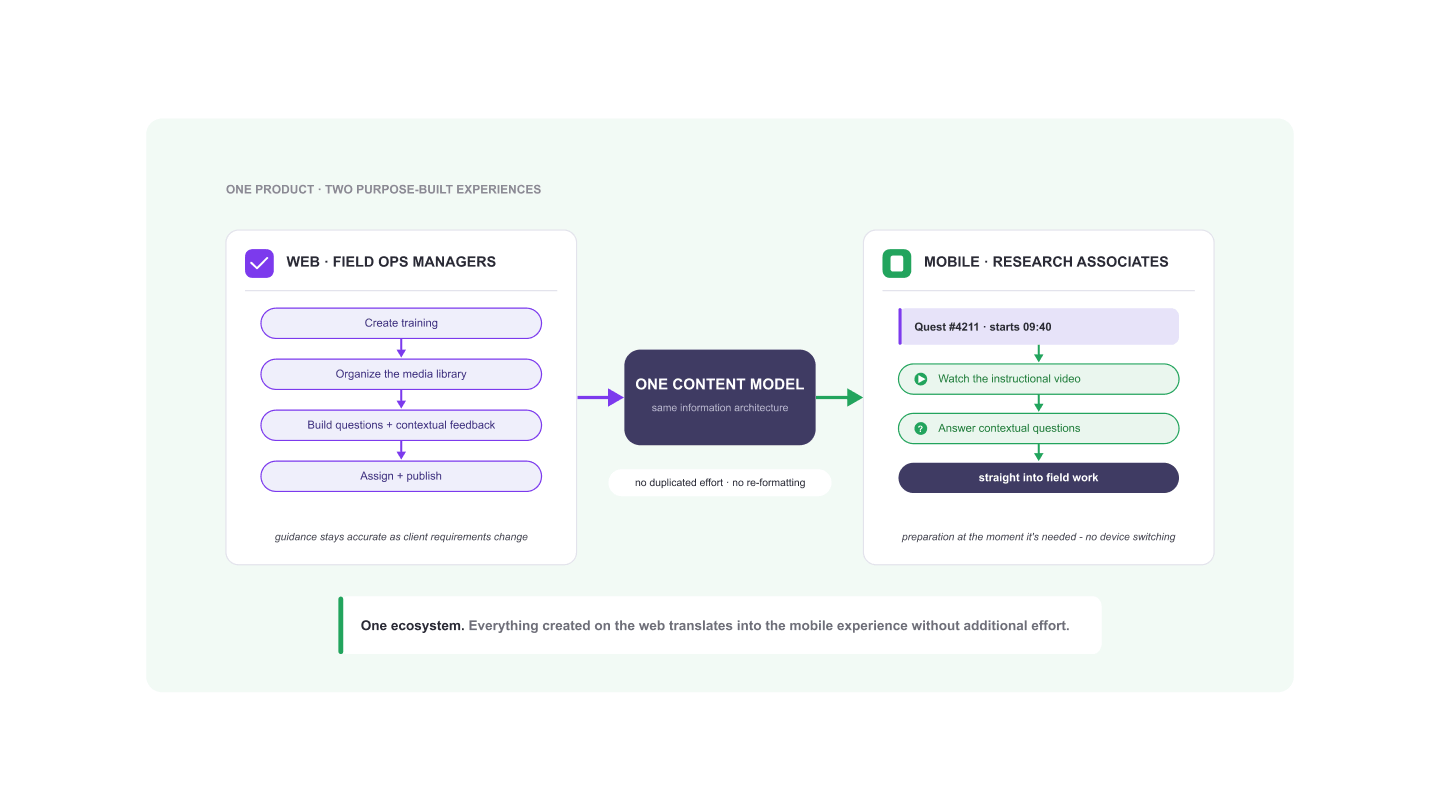
Managers author guidance on the web; Research Associates consume it on mobile, moments before a Quest. Designed independently, they'd become two disconnected products - so I built them as one ecosystem: a single content model and information architecture, where everything created on the web translates into the mobile experience without duplicated effort.
03
Designing the MVP, Not the Entire Roadmap
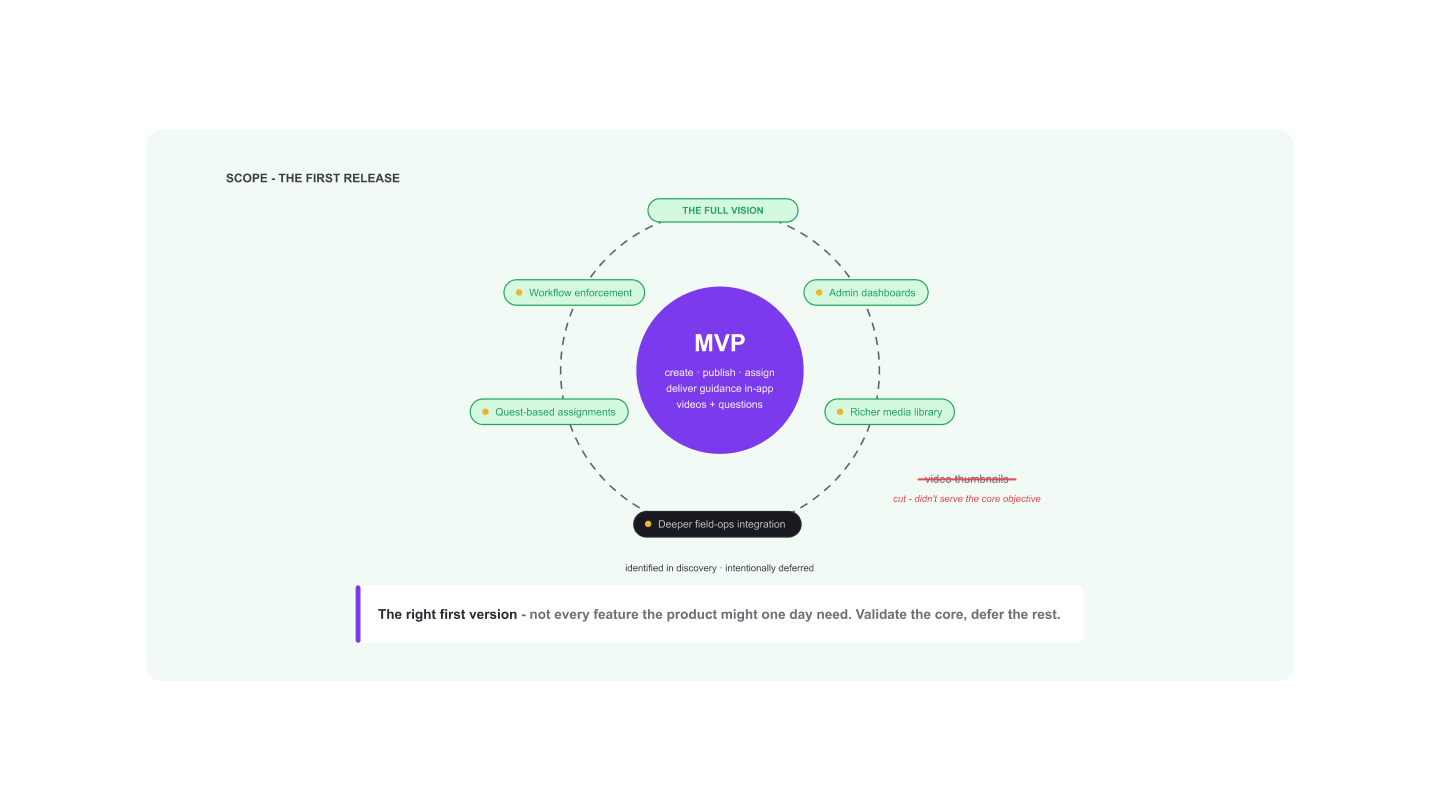
Discovery surfaced a much larger vision - Quest-based assignments, workflow enforcement, dashboards - and the real challenge was deciding what the first release needed to prove. The MVP covers creating, publishing, and delivering guidance inside the existing field workflow; everything else was deferred.
Even small wins were cut. Video thumbnails in the training library were a nice idea that added effort without serving the core objective - and protecting the clarity of the first release mattered more than scope.
Design Solutions
Transition
We weren't building a better Learning Management System. We were designing operational guidance that lives inside the field workflow - and the next challenge was making that real for the people who create guidance and the people who rely on it.
Creating Operational Guidance
Delivering the strategy meant designing for two very different users - those who create guidance and those who rely on it in the field. The challenge wasn't two interfaces; it was making information flow between them effortlessly.
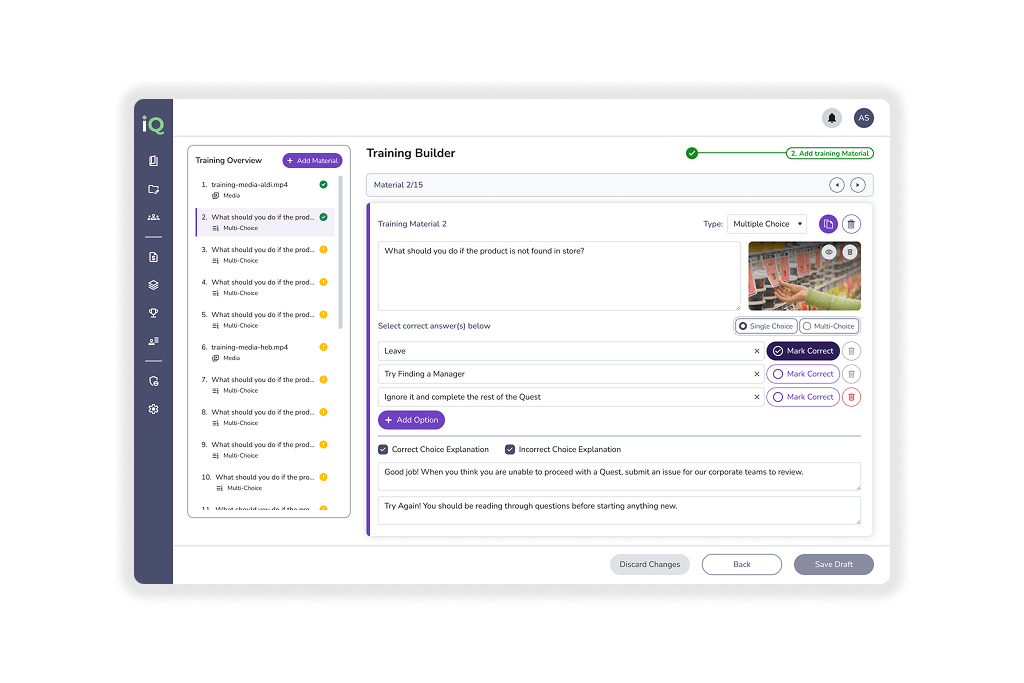
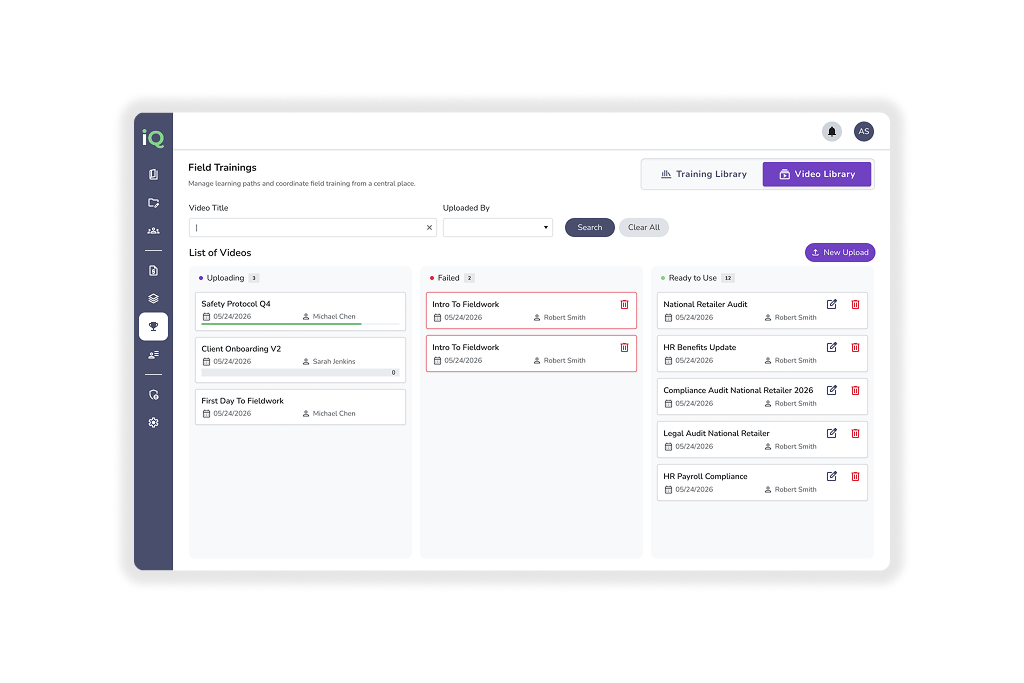
Field Operations Managers weren't uploading videos - they were translating evolving client requirements into guidance Research Associates could rely on. The web experience made that fast: create training, organize media, build questions with contextual feedback, assign, and publish - so guidance stays accurate as client requirements change.
Operational guidance is only valuable if teams can keep it up to date. Simplifying the authoring experience was just as important as improving the learning experience itself.
Delivering Guidance Where Work Happens
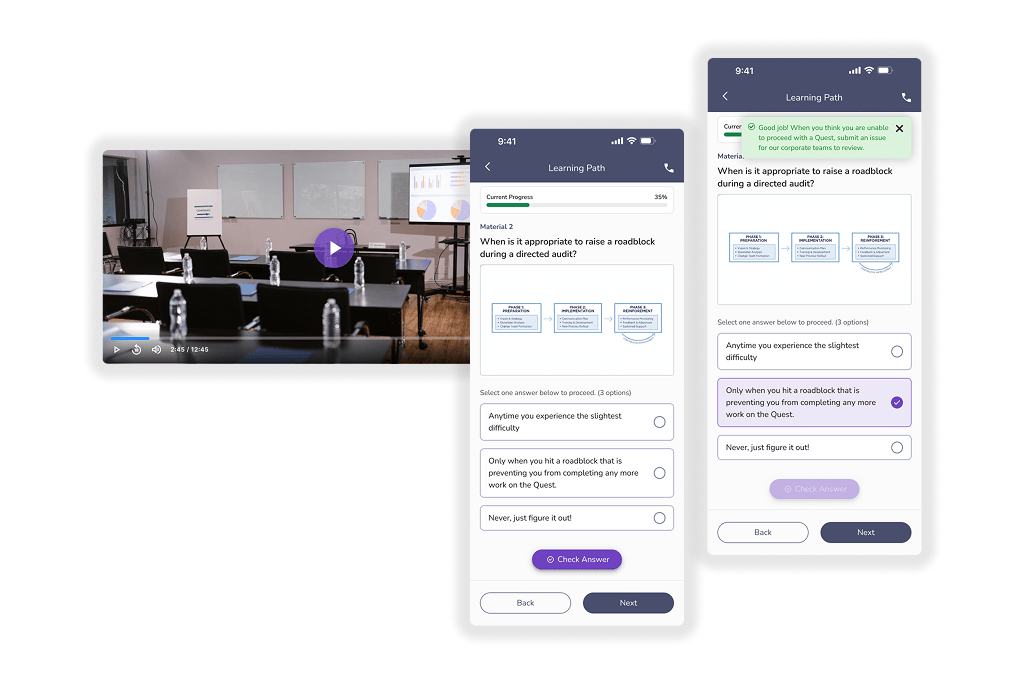
For Research Associates, training was never the destination - it was preparation for the work that followed. Guidance lives directly inside the existing InfoQuest mobile experience: before an unfamiliar Quest, they watch instructional videos, answer interactive questions, and get immediate feedback without switching devices, then move straight into their field work.
The best moment to provide guidance isn't during onboarding - it's immediately before someone needs to apply it.
Designing Beyond the MVP
The architecture leaves room for what comes next: Quest-based assignments, workflow enforcement, richer media, administrative dashboards - identified during discovery, intentionally deferred. The goal wasn't to build everything the product might one day need; it was to build the right first version.
Closing Transition
By embedding guidance into the existing workflow, training shifted from a disconnected activity to part of field execution. The MVP hasn't launched - but its design decisions already set a stronger foundation for how Research Associates prepare and how Field Operations teams deliver guidance at scale.
Outcomes & Reflection
Where We Are Today
This project is under development, with the MVP planned for release in early 2027. Because it hasn't launched, the story here isn't post-launch metrics - it's how reframing the problem produced a product that fits both the business and its users.
From Fragmented Training to Connected Guidance
The most meaningful outcome wasn't a new feature - it was where guidance now lives in the product experience.
| Before | After |
|---|---|
| Desktop-only third-party LMS | Guidance integrated into InfoQuest |
| Separate training workflow | Unified operational experience |
| Device switching before field work | Mobile-first preparation within the existing workflow |
| Generic learning platform | Contextual guidance for client-specific Quests |
| External platform dependency | Foundation for an integrated internal solution |
This transformation moved training from being an isolated activity to becoming part of the work itself.
Looking Back
When this project began, I believed I was designing an LMS. In reality, I was solving a different problem: not helping people learn, but helping them perform unfamiliar work with confidence. That changed what I asked of every design decision.
Feature requests often describe a proposed solution. Discovery uncovers the real problem.
Once the real problem was clear, features that felt obvious became unnecessary - and simple workflow improvements became the most valuable work. For me, that's the rewarding part of product design: not designing better interfaces, but designing the right product.
Final Closing
The best solutions aren't always the ones with the most features. Sometimes they're the ones that quietly remove friction, fit into the workflow, and help people do their work with greater confidence. This was one of those projects.
 Mobile • Visual DesignDesigning Trust for Sensitive Health Journeys
 Enterprise IoT • DashboardsDesigning for High-Stakes Operations
 Multi-surface DesignKeeping the Night Alive
 Enterprise • Data VisualizationMaking Audit Data Useful